
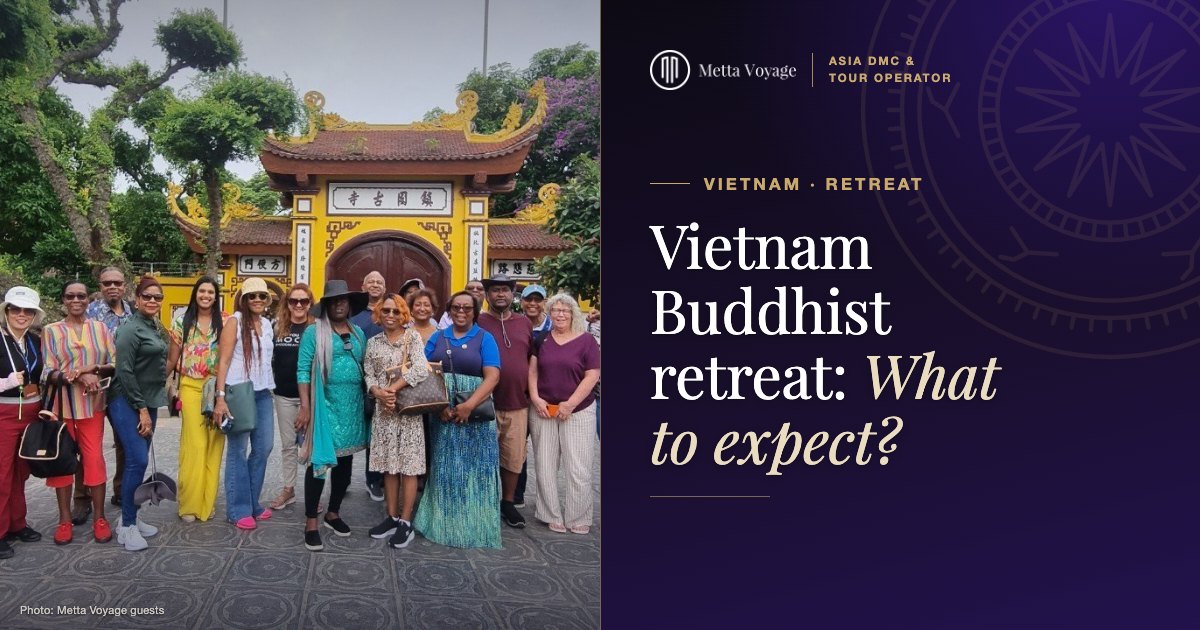
If you’re traveling to Vietnam and looking for a personal exploration of the Buddhism culture, there’s no better way than a Buddhist retreat. Similar to a wellness retreat, a Vietnam Buddhist retreat is a spiritual adventure where you will be immersed in the ancient underlying culture of Buddhism in this beautiful Southeastern country while searching and connecting with your inner peace.
However, going on a Buddhist retreat can be considerably more difficult than spending your retreat in a beachside luxurious resort. So what should you expect in a Buddhist retreat in Vietnam?
1. Preparation
How do you know if you are prepared for the silence, the discipline, and the mental intensity of a Buddhist meditation retreat in Vietnam? The answer is, you don’t, and more importantly, you don’t need to. The purpose of a Buddhist meditation retreat is to relieve you from the constant expectation and evaluation in daily life, from fear of inadequacy and hesitation.
Apart from the essentials that you’re advised to by your chosen monastery, just bring your readiness to the Buddhist retreat. Readiness can be compelling and even devastating, but it requires no preparation.

2. Meditation
Meditation is the utmost basic and essential form of retreat. In a Buddhist retreat in Vietnam, along with other daily practice, you are encouraged to take time off for a longer and deeper experience of meditation. You will leave behind the normal life routine in order to be alone with only your mind, body and spirit.
Surprisingly, complete Zen meditation involves a lot of bodywork and flexibility when, for example, stretching or sitting in the lotus position. Don’t worry, beginners will be instructed very closely.
3. Ritual
Ritual is a crucial part of a Buddhist retreat in Vietnam, and you will probably be expected to participate in a ritual or religious observances of the temple or monastery. It could be somewhat uncomfortable for Westerners or those of other religions to make obeisance to gilded Buddha figures. So thoroughly read about Buddhism and Buddhist rituals before considering a Buddhist retreat in Vietnam to ensure your mental comfort at best.
Other than that, a Buddhist retreat in Vietnam is the most practical and useful way to learn about this enriched ancient religion and culture. On this spiritual path of a Buddhist retreat in Vietnam, you are likely to reach a greater depth of knowledge and more immersive experience of the spiritual practice than you could ever find in any books before.

4. Comfort
Be aware that a Buddhist retreat in Vietnam is not a spa or a luxurious resort. There’s a high chance that the temple or monastery can only provide you with the essentials, accommodation, food and clothes.
You will be sharing the bedroom and bathroom as well as other facilities with other retreaters. Further, you will follow the schedule and disciplines, including a sunrise meditation or chanting service before dawn, so don’t count on sleeping in. Some monasteries may also expect you to help with the chores, such as cooking, dishwashing or cleaning, during your stay.
However, in return, you will be spending your meditation retreat in the peaceful and tranquil space of a beautiful ancient Buddhist monastery or temple, surrounded by marvelous scenery of mountains and greenery, in the beautiful Southeastern country of Vietnam. What a bargain!
5. Block all exits
The most challenging part of a Buddhist meditation retreat in Vietnam is perhaps leaving your normal life behind. This includes leaving sights of your laptop, phone or any technological devices that can be a distraction on your journey towards inner peace. At times, it even requires cutting off any of your social relations from the outside world, for as long as your retreat will be.
It takes a lot of courage to undertake a Buddhist retreat, to hit a pause in life and face your mind directly. Without your usual entertainments and activities to distract you, the only thing you are left with is your mind, both the wisdom and calm and the speed and confusion. It won’t be fun, and could even be disturbing at first, but gradually you will settle down and learn to appreciate the meditative experience of being grounded, open, and awake at a Buddhist retreat in Vietnam.

6. Recommendation of Vietnam Buddhist retreat
Located on the mountainside of the Phoenix Summit (locally known as Nui Phuong Hoang) in Dalat, an only a six-hour drive from central Ho Chi Minh city, Truc Lam Monastery is an ideal destination if you’re considering a Buddhist meditation retreat in Vietnam. Graciously surrounded by towering pine trees and overlooking an open poetic natural scenery around Tuyen Lam Lake, Truc Lam Monastery has been a haven on earth for its peace and tranquility since its public opening in 1994.
During a Buddhist retreat at Truc Lam Monastery, you will be practicing to live in full awareness while putting your minds into a peaceful state. The introspective training process of interior concentration leads to personal purification and helps one’s good nature to surface.
Plan your Vietnam trip in 1 minute
Pick your month to see the weather by region, or estimate your budget — then get a private itinerary from our Hanoi team.
Typical seasonal patterns; weather varies year to year. Our team checks your exact dates when we prepare your itinerary.
"From" prices published on our Vietnam tour cost guide: per person per day, 2 travellers sharing, private guide & driver, hotels, listed activities. International flights, e-visa, insurance and tips not included. Final price is confirmed in your written quote.
There are several ways for visitors to access Truc Lam Monastery in Dalat for a Buddhist retreat, by a hike up to the direct entrance or by a 2.3km cable ride from Robin Hill. There is no published retreat programme for foreign visitors, so if you would like to join the monks for meditation, arrange it with the monastery in advance.
7. Other places to experience Buddhist practice in Vietnam
Truc Lam in Dalat is the best-known Zen monastery for visitors, but it is not the only option. In Hue, the former imperial capital, Tu Hieu Pagoda is the root temple of Zen master Thich Nhat Hanh, the founder of the Plum Village tradition, who spent his final years there and passed away at the temple in January 2022. Its lotus ponds, pine hills and simple wooden halls make it one of the most peaceful places in Central Vietnam for a quiet morning of walking meditation. Hue also has dozens of smaller pagodas along the Perfume River, and Thien Mu Pagoda is an easy first stop.
In the north, pilgrimage sites such as the Perfume Pagoda and the mountain pagodas of Yen Tu, the cradle of the Vietnamese Truc Lam Zen school, are better suited to a day of reflection than a long silent stay. They are busy during the Lunar New Year festival season, so come outside the first three lunar months if you want calm.
8. How to plan a Buddhist retreat in Vietnam
Choose the right length
Most first-time visitors are happiest with a gentle introduction: one or two early mornings of meditation and chanting at a monastery, combined with a few nights in a quiet hotel nearby. If you already have a regular practice, three to seven days gives the mind enough time to settle. Formal residential retreats in Vietnamese monasteries are usually organised for Vietnamese Buddhists and taught in Vietnamese, so for a longer stay you will need a temple that welcomes foreigners and, ideally, an interpreter.
Pick the season
Dalat is cool all year round, with a drier season from about December to April. Hue is at its best from roughly February to May; the heavy rains usually arrive from September to December. Avoid major Buddhist festivals and the Lunar New Year if you are looking for silence, or join them deliberately if you want to see the temples at their most devoted.
Comfort and etiquette
A monastery bed is a thin mattress and the food is simple vegetarian fare. If that is too much, you can still have a meaningful experience: sleep in a comfortable hotel and join the monks only for the dawn sitting, a dharma talk or a vegetarian lunch. Wherever you stay, cover shoulders and knees, take off your shoes before entering a hall, never point your feet at a Buddha statue or a monk, and ask before taking photos. A small donation to the temple is the customary way to say thank you.
A sample day
A typical day starts with the bell at around 4 to 5 am, followed by chanting and sitting meditation. Breakfast is eaten in silence, then the morning is given to walking meditation, a talk or work around the temple. After a vegetarian lunch there is time to rest, read or sit by the lake, and the day closes with evening chanting and an early night. Even on a shorter programme, following this rhythm for a day or two is the best way to understand what monastic life feels like.
9. How Metta Voyage can help
Arranging a stay at a monastery is rarely something you can do online. Our local team can contact the temple in advance, provide an English-speaking guide who knows Buddhist etiquette, and combine your practice with comfortable accommodation and private transfers. See our meditation retreat in Vietnam itinerary, browse our wellness and health tours, or add a few quiet days to one of our Da Lat tours.
Frequently asked questions
Do I need to be a Buddhist to join a retreat in Vietnam?
No. Vietnamese monasteries welcome visitors of all faiths. You will be asked to respect the rules and join the daily schedule, but nobody expects you to convert or to know the chants.
Can I stay overnight at Truc Lam Monastery?
The monastery is mainly a place for monks, nuns and Vietnamese practitioners, and there is no published programme for foreign retreatants. Visitors can usually join meditation if it is arranged with the monks beforehand. For an overnight stay, ask in advance and have a backup hotel in Dalat.
What should I bring?
Loose, modest clothes in light colours, a light jacket for cold Dalat mornings, slip-on shoes, a notebook and any medication you need. Leave valuables at the hotel.
Are retreats taught in English?
Usually not. Talks and chanting are in Vietnamese, so an interpreter or a guide familiar with Buddhist practice makes a big difference, especially for a stay of more than a day.
How long is a Buddhist retreat in Vietnam?
Anything from a single morning to several weeks. For most travellers, one to three days of practice built into a longer private tour is the most rewarding balance.
A Buddhist retreat in Vietnam is the perfect opportunity for you to spend some quality time learning and connect with your mind. A meditation retreat is the best way to release one’s self from the captive of the burdened mind, and the imprisonment of your making. Once you’re free from the usual distractions of bustling life and the mind settles in retreat, the benefits unfold. You can now step fully into the world without being controlled by it.
Visit Metta Voyage now to get updates on interesting and useful information about wellness lifestyle & holiday!
Plan this trip
- Vietnam North To South (join-in group tour) (10 days, from US$1,400 per person)
- Best Vietnam Itinerary 11 days: Sai Gon to Hanoi (11 days, from US$1,540 per person)
See what a private two-week Vietnam trip costs, or get a free tailor-made itinerary from our team.