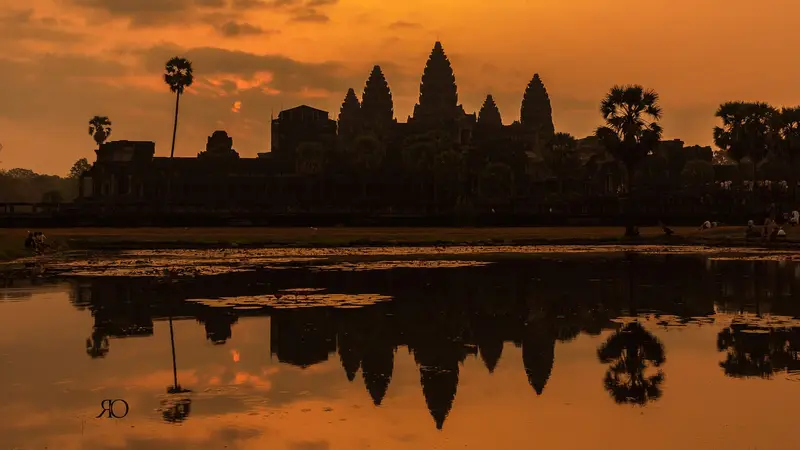

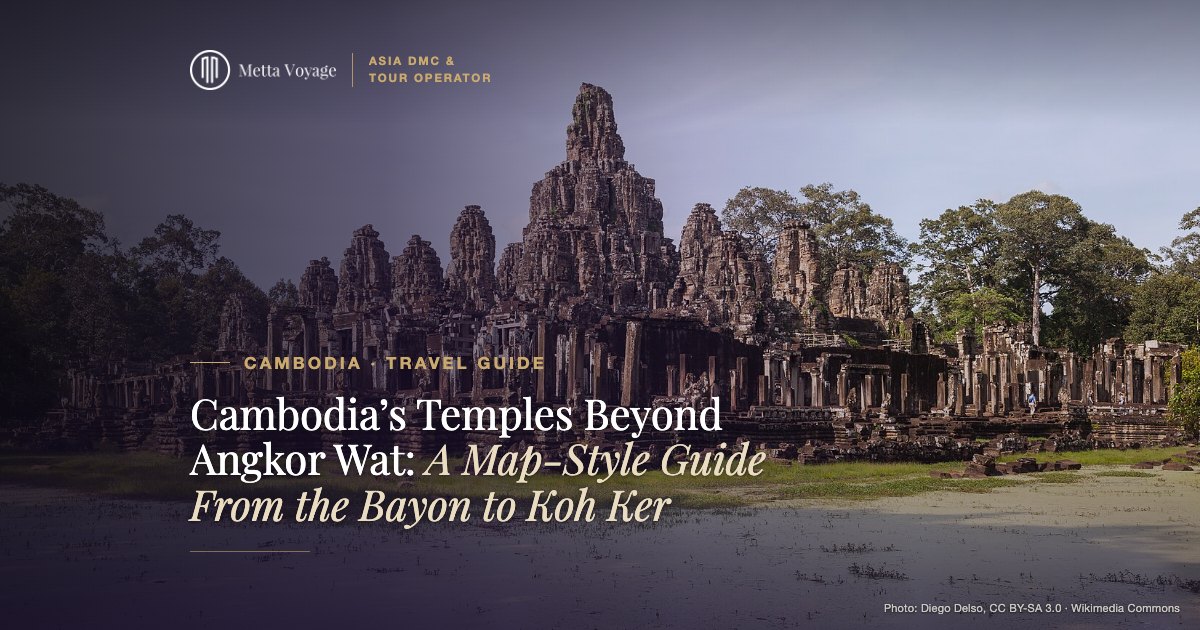
Most visitors to Cambodia see Angkor Wat, and many leave thinking they have seen Angkor. In fact the temple is one monument among hundreds, spread across a landscape that the Khmer empire shaped for some six centuries. The Bayon’s stone faces, the trees growing through Ta Prohm, the fine carving of Banteay Srei and the forest-swallowed ruins of Beng Mealea are each a different experience, and several of them are quieter than Angkor Wat at sunrise.
This page is designed to be saved: a sketch map, one table with distances, timing and who each temple suits, and three routes you can follow. If you are looking for a day-by-day plan with prices, see our separate 3-day Angkor Wat itinerary. This guide is the reference that sits next to it.
The map: where the temples are
Siem Reap town sits between the main temple park to the north and the Tonle Sap lake to the south. The core temples are close together, a 15 to 30 minute drive from most hotels. The outer and far temples fan out to the north-east and east, along roads that are now mostly paved.
The temple table
Distances and drive times are approximate and assume a private car from central Siem Reap; traffic, road works and the season change them. “Steps” notes are for families with teenagers and for older travellers who want to avoid steep climbs.
| Temple | Why go | From Siem Reap | Best time | Time needed | Who it suits | In our tours |
|---|---|---|---|---|---|---|
| Angkor Wat | The largest religious monument of the Khmer empire, built in the 12th century; long galleries of bas-reliefs. | ~6 km, 15 min | Sunrise, or afternoon when the west face is lit | 2-3 hours | Everyone. Ground level is flat; the upper level (Bakan) is a steep staircase with a handrail and can be skipped. | Siem Reap Classic, Enchanting Angkor and Tonle Sap and most of our Cambodia trips |
| Angkor Thom and the Bayon | The walled royal city; the Bayon’s towers carved with serene faces, plus the Baphuon and the Elephant Terrace. | ~9 km, 20 min | Early morning | 2-3 hours | Families and most older travellers; the Bayon has uneven steps, the Baphuon is steeper. | Siem Reap Classic, Enchanting Angkor and Tonle Sap, Like A Local 14 Days |
| Ta Prohm | Silk-cotton and fig trees growing through the ruins; the most photographed jungle temple. | ~10 km, 20-25 min | Opening time or late afternoon | 1-1.5 hours | Very good for families; mostly flat with boardwalks, some rubble and narrow passages. | Siem Reap Classic, Enchanting Angkor and Tonle Sap, Like A Local 14 Days |
| Phnom Bakheng | Hilltop temple with views over the forest towards Angkor Wat. | ~7 km, 15 min | Sunset (busy; visitor numbers at the top are limited) | 1 hour | Teens yes. A 15-20 minute uphill walk and steep final steps; not ideal for bad knees. | Enchanting Angkor and Tonle Sap, Vietnam Cambodia 14 Days (Vespa) |
| Preah Khan | A huge, partly ruined monastery with very long corridors; quieter than Ta Prohm. | ~12 km, 25 min | Morning or mid-afternoon | 1-1.5 hours | Good for older travellers: flat, with uneven paving. | Enchanting Angkor and Tonle Sap, Siem Reap and Phnom Penh Escape, Like A Local 14 Days, Indochina Off The Beaten Track |
| Neak Pean | A small temple on an island in an ancient reservoir, reached by a long causeway. | ~14 km, 30 min | Morning | 30-45 min | Easy flat walk; pleasant in the wet season when the reservoir is full. | Siem Reap and Phnom Penh Escape, Cultural Gems of Phnom Penh and Siem Reap, Like A Local 14 Days |
| Ta Som, East Mebon, Pre Rup | The “grand circuit”: a face-tower gate wrapped by a tree, elephant statues, and a red-brick temple-mountain. | 12-16 km, 25-35 min | Afternoon; Pre Rup for sunset | 2-3 hours for all three | Ta Som is flat; East Mebon and Pre Rup have steep steps. | Siem Reap and Phnom Penh Escape, Like A Local 14 Days, Pre Rup in Enchanting Angkor and Tonle Sap |
| Banteay Kdei, Srah Srang, Ta Keo | A quiet monastery, a royal bathing pool and an unfinished temple-mountain. | ~10-12 km, 20-25 min | Morning; Srah Srang at sunrise | 1.5 hours | Banteay Kdei and Srah Srang are easy; Ta Keo is very steep. | Siem Reap and Phnom Penh Escape, Like A Local 14 Days, Banteay Kdei in Enchanting Angkor and Tonle Sap |
| Banteay Srei | Small 10th-century temple in pink sandstone with the finest carving at Angkor. | ~35-40 km, 45-60 min | Early morning before groups, or late afternoon | 1 hour | Ideal for older travellers: compact and flat. | Enchanting Angkor and Tonle Sap, Like A Local 14 Days |
| Banteay Samre | Well-restored temple in the style of Angkor Wat, often almost empty. | ~15-20 km, about 30 min | On the way to or from Banteay Srei | 45 min | Easy; some steps. | Enchanting Angkor and Tonle Sap, Like A Local 14 Days |
| Roluos group (Bakong, Preah Ko, Lolei) | The earliest capital of the Angkor period; Bakong is an early temple-mountain. | ~13 km, 20-30 min | Late afternoon | 1.5-2 hours | Easy; Bakong has moderate steps with good views. | On request |
| Kbal Spean | Carvings of Hindu gods and lingas in a forest riverbed. | ~50 km, about 1 h 15 | Morning, before the heat | 2.5-3 hours incl. walk | Teens yes. About 1.5 km uphill on a rocky forest path each way; not for limited mobility. | On request |
| Phnom Kulen | Sacred mountain where the Angkor empire was proclaimed; riverbed lingas, a reclining Buddha and a waterfall. | ~50 km, about 1.5 h | Morning; waterfall best in or just after the wet season | Half to full day | Families with teens who like a swim; steps up to the reclining Buddha. | Vietnam Cambodia 14 Days (Vespa) |
| Beng Mealea | A vast 12th-century temple left largely unrestored, collapsed and overgrown, crossed by wooden walkways. | ~65-70 km, about 1.5 h | Morning | 1.5-2 hours | Teens love the scrambling; older travellers can stay on the walkways. | On request |
| Koh Ker | A 10th-century capital with a seven-tiered pyramid (Prasat Thom); a UNESCO World Heritage Site since 2023. | ~120 km, about 2.5 h | Full day, often with Beng Mealea | Full day | Patient travellers who do not mind a long drive; climbing access to the pyramid can change, so check on the day. | On request |
“On request” means the temple is not in our published itineraries, but it can be arranged on a private itinerary on request. Opening hours at most temples run roughly from 7:30 to 17:30; Angkor Wat and Srah Srang open earlier for sunrise and Phnom Bakheng and Pre Rup stay open later for sunset. Check the current hours when you buy your pass.
Three routes to save
Day 1: the classic circuit
Start early at the Bayon and Angkor Thom, while the morning light falls on the faces and before the heat. Continue to Ta Prohm, then return to your hotel for lunch and a rest. In the afternoon, visit Angkor Wat, when its western face is lit and the morning crowds have gone. If you want the famous sunrise, go to Angkor Wat at dawn instead and swap the order. Our Siem Reap Classic trip (from US$420 per person) follows this pattern, with a boat trip on the Tonle Sap on arrival day.
Day 2: the outer temples
Option A, the grand circuit: Preah Khan in the morning, then Neak Pean, Ta Som and East Mebon, with Pre Rup for sunset. Option B, the north-east: Banteay Srei early, Banteay Samre on the way back, and an easy afternoon. Option B suits older travellers best, because both temples are compact and mostly flat. Our Enchanting Angkor and Tonle Sap itinerary (from US$560 per person) includes Banteay Srei and Banteay Samre on one day and Preah Khan, Ta Prohm, Banteay Kdei and Pre Rup on another, ending with sunset at Phnom Bakheng.
Day 3: the far temples
Leave around 7:00 with a packed breakfast. Beng Mealea comes first, about 1.5 hours away, while the forest is still cool. Continue to Koh Ker for lunch nearby and an afternoon among its scattered temples, then drive back to Siem Reap; it is a long day, with about five hours in the car in total. A shorter alternative is Kbal Spean in the morning followed by Banteay Srei and the Roluos group on the way back. Both of these routes can be arranged on a private itinerary on request.
The Angkor Pass in brief
The Angkor Pass covers the temples in the main archaeological park, including Banteay Srei, Kbal Spean and the Roluos group. There are three types:
| Pass | Validity | Best for |
|---|---|---|
| 1-day pass | One day of visits | A short stopover or a single temple day |
| 3-day pass | Three days, used within 10 days | Most travellers; allows rest days in between |
| 7-day pass | Seven days, used within one month | Slow travel, photographers, temple enthusiasts |
Prices change from time to time, so check the current price before you travel. The pass carries your photo, and you need to show it at temple entrances, so keep it with you. Beng Mealea, Koh Ker and Phnom Kulen are not covered and each has its own ticket. On our tours, entrance fees for the temples listed in the programme are included, and your guide handles the pass.
Temple-day checklist
- Shoulders and knees covered (needed for the upper level of Angkor Wat).
- Comfortable shoes with good grip for worn, uneven steps.
- Hat, sunglasses and sunscreen; most temples have little shade.
- Refillable water bottle; plan a midday break at your hotel.
- Angkor Pass with your photo, kept in a dry pocket.
- Small notes for drinks and for donations at active shrines.
- Light rain jacket from June to October.
- Torch or phone light for dark corridors at Beng Mealea and Preah Khan.
- For teens: a camera and a sketchbook keep them engaged on day three.
Beyond Siem Reap: Phnom Penh and Battambang
Phnom Penh
The capital has Cambodia’s most important living temples. The Royal Palace, built from 1866, and the Silver Pagoda beside it, with Buddha statues decorated with gold and precious stones, are a must for anyone interested in Khmer art; shoulders and knees must be covered. Wat Phnom, on the small hill that gave the city its name, is where local people come to pray for luck. Our Phnom Penh Cultural Exploration trip (from US$420 per person) covers the palace, the Silver Pagoda, the National Museum and the hill of Phnom Daun Penh, and the Siem Reap and Phnom Penh Escape (from US$840 per person) and Cultural Gems of Phnom Penh and Siem Reap (from US$700 per person) itineraries combine Phnom Penh with two days at Angkor.
Battambang
Cambodia’s second city, a few hours west of Siem Reap, is relaxed and full of colonial-era shophouses. Its temples are less visited: Wat Ek Phnom, an 11th-century Angkorian temple beside a modern pagoda, and Phnom Sampeau, a hill topped by a temple, with caves that are a moving memorial to the Khmer Rouge years. At dusk, millions of bats stream out of a cave at its foot. Our 15-day Indochina Off The Beaten Track tour (from US$2,100 per person) includes Wat Slaket, Wat Ek Phnom, Phnom Sampeau and the bamboo train, after the Angkor temples and a boat trip on the Tonle Sap.
To combine these temples with Vietnam or Laos, see our Cambodia tours. The Like A Local 14 Days journey (from US$1,960 per person) starts in Siem Reap with two full temple days, including Banteay Srei and the grand circuit, and the Vietnam Cambodia 14 Days (Vespa) itinerary (from US$2,341 per person) ends with a day on Phnom Kulen.
Frequently asked questions
Which temples are worth seeing beyond Angkor Wat?
The Bayon and Ta Prohm are essential, and most travellers love them as much as Angkor Wat. With a second day, add Preah Khan, Neak Pean and Banteay Srei. With a third, Beng Mealea and Koh Ker show what the forest does to an unrestored temple and how far the Khmer empire reached.
How far is Banteay Srei from Siem Reap?
Roughly 35 to 40 km by road, or about 45 minutes to an hour by car. It is usually combined with Banteay Samre on the way, or with Kbal Spean further north.
Is Beng Mealea or Koh Ker included in the Angkor Pass?
No. Beng Mealea, Koh Ker and Phnom Kulen are managed separately and each has its own entrance ticket. Check the current price before you go, or ask us to include the fees in a private itinerary.
Which Angkor temples are best for older travellers or anyone with bad knees?
Banteay Srei, Ta Prohm, Preah Khan, Neak Pean and the ground level of Angkor Wat are mostly flat, with some uneven paving. Avoid the steep upper levels of Angkor Wat, Ta Keo and Pre Rup, the climb to Phnom Bakheng and the forest walk to Kbal Spean if stairs or slopes are difficult.
How many days do I need to see the temples beyond Angkor Wat?
Three days is a comfortable minimum: one for Angkor Wat, the Bayon and Ta Prohm, one for the outer temples and Banteay Srei, and one for a far temple such as Beng Mealea or Koh Ker. Our 3-day itinerary guide shows a gentler version with the Tonle Sap lake.
If you would like us to turn this map into a private temple itinerary at your own pace, tell us your dates on our contact page.
Written by the Metta Voyage travel team. Last updated October 2026.