
In our experience as trip planners, two weeks is a comfortable length for a first trip to Vietnam that runs from north to south. It is long enough to see the mountains of the north, a night among the limestone islands of Halong Bay, the lantern-lit old town of Hoi An and the rivers of the Mekong Delta, without spending every other day in transit. This is the day-by-day plan of our Best of Vietnam 14 Days tour, with notes on pace, hotels, weather and what to change if you prefer a slower trip.
The 14-day itinerary at a glance
| Day | Route and highlights | Meals |
|---|---|---|
| 1 | Arrive in Hanoi, private transfer to your hotel | – |
| 2 | Hanoi city tour | B, L |
| 3 | Day trip to Ninh Binh: Hoa Lu ancient capital and the Tam Coc boat ride | B, L |
| 4 | Hanoi to Sapa, trek to Lao Chai and Ta Van villages | B, L |
| 5 | Fansipan Peak | B, L |
| 6 | Free morning in Sapa, drive back to Hanoi | B |
| 7 | Hanoi to Halong Bay, overnight cruise | B, L, D |
| 8 | Morning on the bay, evening flight to Da Nang (after 6 pm) | B, brunch |
| 9 | Coconut jungle and Hoi An Ancient Town | B, D |
| 10 | Ba Na Hills and the Golden Bridge | B, L |
| 11 | Fly to Ho Chi Minh City | B |
| 12 | Ho Chi Minh City and the Cu Chi Tunnels | B, L |
| 13 | Mekong Delta discovery | B, L |
| 14 | Departure from Ho Chi Minh City | B |
B = breakfast, L = lunch, D = dinner. From US$1,455 per person for the whole tour, based on 3–4 adults sharing twin/double rooms in the listed hotels (mainly 4★, 5★ Halong Bay cruise); domestic flights are not included in this price. The final price depends on your dates, group size and hotel level. Full itinerary, hotels and inclusions: Best of Vietnam 14 Days tour.
Days 1–6: Hanoi, Ninh Binh and Sapa
You start in Hanoi, the most atmospheric of Vietnam’s big cities. After a first evening to recover from the flight, the city tour covers the essentials: the Old Quarter’s narrow streets, Hoan Kiem Lake, the Temple of Literature and a coffee stop, because Hanoi’s coffee culture is part of the visit. Your guide adapts the pace and the stops to what interests you.
Day 3 is a full day in Ninh Binh, two hours south, where rice fields sit between steep limestone mountains. You visit Hoa Lu, Vietnam’s capital a thousand years ago, and take a rowing boat along the river at Tam Coc, through caves and between paddies. It is one of the most photogenic days of the trip and a good warm-up for the countryside.
From Hanoi the expressway brings you to Sapa in the north-west in around five to six hours. The afternoon walk to the villages of Lao Chai and Ta Van follows paths between rice terraces and is suitable for anyone reasonably fit; your guide sets the distance. Day 5 is reserved for Fansipan, at about 3,140 metres the highest mountain in Indochina, reached by cable car. On day 6 you have a free morning before the drive back to Hanoi.
Days 7–8: Halong Bay overnight
The night on a cruise boat is a highlight for almost everyone. From Hanoi it is about two and a half hours to the harbour; by lunchtime you are sailing among the limestone islands. Activities depend on the boat and route, typically kayaking, a cave visit and a sunset on deck. The next morning there is time on the bay before brunch and the transfer for the evening flight to Da Nang. The cruise you choose affects both the experience and the price, so we propose boats that suit your style and budget.
Plan your Vietnam trip in 1 minute
Pick your month to see the weather by region, or estimate your budget — then get a private itinerary from our Hanoi team.
Typical seasonal patterns; weather varies year to year. Our team checks your exact dates when we prepare your itinerary.
"From" prices published on our Vietnam tour cost guide: per person per day, 2 travellers sharing, private guide & driver, hotels, listed activities. International flights, e-visa, insurance and tips not included. Final price is confirmed in your written quote.
Days 9–10: Hoi An and Ba Na Hills
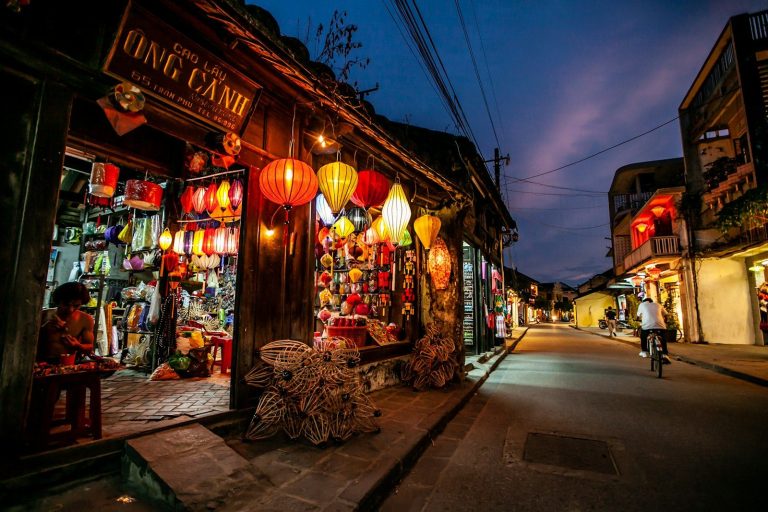
Hoi An’s old town is a UNESCO World Heritage site of yellow merchant houses, assembly halls and lanterns along the Thu Bon River. Day 9 starts in the coconut jungle of Cam Thanh, where round basket boats glide through the water palms, and ends in the old town in the evening, when the lanterns are lit. On day 10 you visit Ba Na Hills and the Golden Bridge held by giant stone hands, high above Da Nang. If you prefer a quieter day, many guests swap Ba Na Hills for a cooking class, a bicycle ride through the villages or simply time at the beach.
Days 11–14: Saigon and the Mekong Delta
A short flight takes you to Ho Chi Minh City, still called Saigon by most locals: busy, modern and full of energy. Day 12 combines the city’s landmarks with the Cu Chi Tunnels, the underground network used during the war. Day 13 is spent in the Mekong Delta, travelling by boat through canals lined with coconut palms, visiting local workshops and orchards. Day 14 is your departure from Ho Chi Minh City.
Shorter, slower or longer versions
| Version | Route | From, per person |
|---|---|---|
| 14 days (this route) | Hanoi, Ninh Binh, Sapa, Halong Bay, Hoi An, Ba Na Hills, Saigon, Mekong | US$1,455 (3–4 adults sharing, mainly 4★ hotels; domestic flights extra) |
| 10 days | Hanoi, Ninh Binh, Halong Bay, Hoi An, Ba Na Hills, Saigon, Mekong (without Sapa and the Hanoi city day) | US$996 (3–4 adults, January–April 2027) |
| 12 days, slower pace | A different route through the north and centre only: Hanoi, Mai Chau, Pu Luong, Ninh Binh, Halong Bay, Hoi An, Ba Na Hills and a free day in Hoi An. It is slower because you change hotels less often and spend more time in the countryside, not because it has fewer days; it leaves out Sapa, Saigon and the Mekong Delta. | US$1,340 (final price confirmed for your dates and group size) |
| 16 days with Cambodia | Adds Angkor and Siem Reap after Saigon | US$2,572 |
Like this route but need different dates or pace?
Tell us your travel dates, group size and hotel style. Our Hanoi team sends a day-by-day version with a price for your dates within 24 hours, with no obligation.
Who this itinerary suits, and when to go
This route works best for first-time visitors who want the classic highlights in one trip, couples, and families with children over about ten who are happy with a short trek. It is less suited to a slow, beach-focused holiday; for that we shorten the route and add two or three nights on the coast.
Vietnam has different climates from north to south, so there is no single perfect month. The north, including Hanoi and Sapa, is cool and sometimes cold from December to February; the centre around Hoi An has its rainy season from roughly September to December; the south is dry from about December to April. Spring (March–April) and autumn (October–November) are good compromises for a north-to-south trip.
Practical tips from our team
- Visa: most visitors enter with an e-visa. Check the official requirements for your nationality before you book flights.
- Packing: bring a warm layer for Sapa and the Halong Bay deck in winter, and comfortable shoes for the village walk.
- Flights: fly into Hanoi and out of Ho Chi Minh City (an “open-jaw” ticket) so you never backtrack.
- Everything can change: add a beach stay, upgrade hotels, or remove a day trip. The price is recalculated for your version.
Frequently asked questions
Is 14 days enough for Vietnam?
Yes, for the main highlights from north to south. With fewer than ten days we recommend focusing on the north and centre only.
Is the tour private?
Yes. You have your own car, driver and guide in each region, and you can change the pace day by day.
What is included in the US$1,455 price?
Hotels and the Halong Bay cruise as listed on the tour page (twin/double rooms, daily breakfast), a private car and driver for all tours and transfers, an English-speaking guide on guided days, entrance fees and boat trips in the itinerary, and the meals listed. Not included: international flights, domestic flights (Hanoi–Da Nang and Da Nang–Ho Chi Minh City, quoted separately), visa, insurance, tips and personal expenses. See how private tour prices are calculated.
Questions travellers asked us — and our answers
These are real questions from travellers’ emails, messages and enquiry forms, rewritten and anonymised, and answered by the Metta Voyage team: a trip designer and a guide.
Will we have the same guide for the whole trip, or a different guide in each region?
Metta Voyage trip designer: On this route you have a local English-speaking guide in each region (the north, Hoi An and Ho Chi Minh City), with your own car and driver, as described in the itinerary. Local guides know their area best, and the guided days are scheduled around them.
Metta Voyage guide: Each of us knows our own region inside out, from the quiet times at the temples to where locals eat. Tell your guide on the first day what you enjoy, and the day changes with you.
Can we do the Ninh Binh boat ride at Trang An instead of Tam Coc?
Metta Voyage trip designer: Yes. Both are rowing-boat trips between limestone mountains, and we can swap one for the other on day 3; the change is confirmed in your quote. Our Trang An guide describes that route.
Metta Voyage guide: Tam Coc is the classic ride through rice fields and three caves. Trang An is a longer loop with more caves and small temples on the way. If you love scenery and do not mind a longer time in the boat, Trang An is a good choice.
Could we take the overnight train from Hanoi to Da Nang instead of flying?
Metta Voyage trip designer: Yes, it can be arranged, but it changes the shape of the trip. The train is a long journey through the night, and on this route the flight to Da Nang leaves on the evening after the cruise, so we would re-plan days 8–9. Our Hanoi to Da Nang train guide explains the options. If you prefer the opposite, no overnight train or boat at all, we can keep the flights and offer a day cruise instead of the night on Halong Bay.
Metta Voyage guide: The train is an experience in itself: you wake up with the coast outside the window. Pack a small overnight bag so you do not need to open your suitcase in the cabin.
Is it better to stay in Hoi An or in Da Nang?
Metta Voyage trip designer: It depends on what you want from those days. Staying in or near Hoi An lets you walk into the old town in the evening, when the lanterns are lit. Da Nang has beach-front hotels and is closer to the airport and to Ba Na Hills. We suggest the base in your quote and can change it.
Metta Voyage guide: If the lantern evenings are the reason you come, stay in Hoi An. If you want a swim every morning, Da Nang works well, and the drive to Hoi An is short.
We are in our fifties and sixties and do not want hard walking. Does this route work for us?
Metta Voyage trip designer: Yes, with a few adjustments. The Sapa village walk can be shortened or replaced by a drive, Fansipan is reached by cable car, and we can drop Ba Na Hills for a quieter day. If you would rather change hotels less often, the 12-day slower route on this page suits you better. For the best months, see the best time to visit Vietnam.
Metta Voyage guide: I set the pace with you every morning. Many of our older guests enjoy the Mekong boat day and the Hoi An evenings the most, and neither needs long walks.
— Metta Voyage team
Written by the Metta Voyage travel team in Hanoi. Last updated October 2026. Prices are the “from” prices published on our tour page (checked 24 October 2026); your quote confirms the exact price for your dates. Photos: Metta Voyage.